
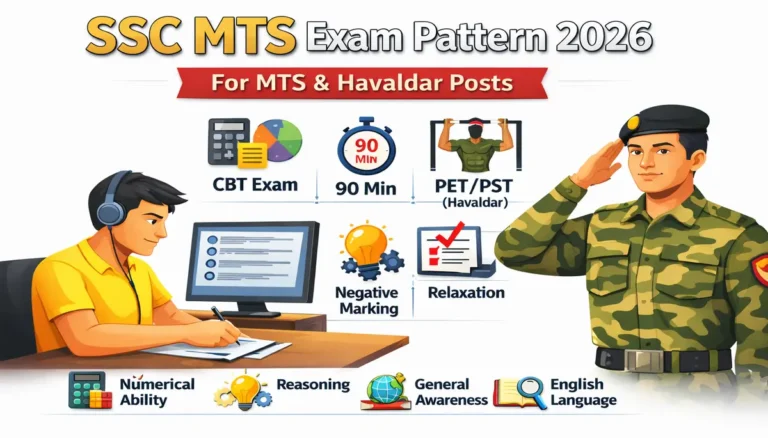
The SSC MTS 2026 examination is conducted by the Staff Selection Commission to recruit candidates for Multi-Tasking Staff (MTS) and Havaldar posts in various central government departments. Every year, lakhs of aspirants appear for this exam, making it essential to stay updated with the latest exam details.
For the 2026 recruitment cycle, SSC has introduced a CBT-based (Computer Based Test) exam pattern, which applies to both MTS and Havaldar posts. The CBT focuses on assessing candidates’ basic numerical ability, reasoning skills, general awareness, and English language comprehension in an objective format.
Understanding the SSC MTS Exam Pattern is a crucial first step in exam preparation. A clear knowledge of the exam structure, marking scheme, and section-wise weightage helps candidates create an effective study plan, manage time efficiently during the exam, and avoid unnecessary mistakes.
What is SSC MTS Exam 2026?
The SSC MTS Exam is a national-level recruitment examination conducted to select candidates for Multi-Tasking Staff (MTS) and Havaldar posts in various ministries, departments, and offices of the Government of India. These posts are classified as Group ‘C’ non-gazetted, non-ministerial positions.
The recruitment process is conducted by the Staff Selection Commission (SSC), which is responsible for organizing the examination, releasing notifications, and completing the selection process.
The SSC MTS 2026 examination is held in Computer Based Test (CBT) mode, where candidates are required to answer objective-type multiple-choice questions. The CBT evaluates candidates on basic subjects such as numerical ability, reasoning, general awareness, and English language skills.
The selection process for SSC MTS 2026 involves:
- Computer Based Test (CBT) – for both MTS and Havaldar posts
- Physical Efficiency Test (PET) / Physical Standard Test (PST) – applicable only for Havaldar posts
- Document Verification – final stage after qualifying all rounds
Understanding the overall structure of the SSC MTS exam helps candidates prepare strategically and focus on each stage effectively.
SSC MTS Exam Pattern 2026 – Overview
The SSC MTS Exam Pattern 2026 is based on a Computer Based Test (CBT) conducted in online mode. The CBT is designed to test candidates’ basic aptitude and awareness required for Multi-Tasking Staff (MTS) and Havaldar posts.
At a glance, the SSC MTS CBT consists of multiple sections covering different subjects, with all questions being objective-type (MCQs). Each section carries equal importance, and candidates must attempt the paper within the prescribed time limit.
Key highlights of SSC MTS Exam Pattern 2026:
- The CBT includes 4 sections:
- Numerical & Mathematical Ability
- Reasoning Ability & Problem Solving
- General Awareness
- English Language & Comprehension
- The exam is conducted for a total of 100 marks
- The total duration of the exam is 90 minutes
- Negative marking is applicable:
- 0.25 marks are deducted for each wrong answer
- The question paper is available in multiple languages, including English, Hindi, and other regional languages, except for the English Language section
Having a clear understanding of the overall SSC MTS 2026 exam structure helps candidates manage time efficiently during the exam and prioritize their preparation according to section-wise weightage.
SSC MTS 2026 CBT Exam Pattern (For MTS & Havaldar)
The SSC MTS 2026 Computer Based Test (CBT) is common for Multi-Tasking Staff (MTS) and Havaldar posts. The exam consists of four sections, with objective-type questions and a fixed time duration.
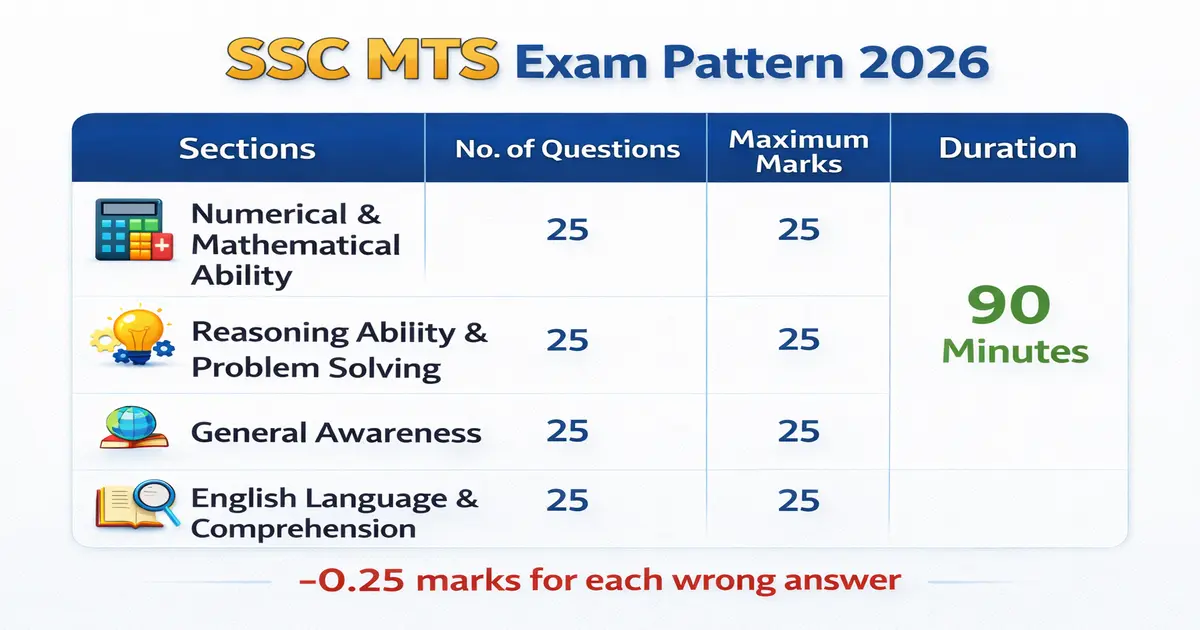
SSC MTS Exam Pattern 2026 – CBT Table
| Section | Subject | No. of Questions | Marks | Time Duration |
|---|---|---|---|---|
| Section-I | Numerical & Mathematical Ability | 25 | 25 | |
| Section-II | Reasoning Ability & Problem Solving | 25 | 25 | |
| Section-III | General Awareness | 25 | 25 | |
| Section-IV | English Language & Comprehension | 25 | 25 | |
| Total | — | 100 | 100 Marks | 90 Minutes |
Important Points to Note
The exam is conducted in English, Hindi, and regional languages (except English section)
The CBT exam pattern is the same for MTS and Havaldar posts
Each question carries 1 mark
Negative marking of 0.25 marks is applicable for every wrong answer
Also Read – SSC MTS Exam 2026: Best Guide to Eligibility, Syllabus & Selection Process
Section-Wise SSC MTS Exam Pattern 2026
The SSC MTS 2026 CBT is divided into four sections, each designed to test different skills required for MTS and Havaldar posts. Understanding the section-wise pattern helps candidates focus on high-scoring areas and manage time effectively during the exam.
Numerical & Mathematical Ability
This section evaluates candidates’ basic mathematical understanding and calculation skills.
- Topics Covered:
Simplification, Percentage, Ratio & Proportion, Average, Profit & Loss, Simple Interest, Time & Work, Time & Distance, Mensuration, Number System - Number of Questions: 25
- Marks: 25
This section is scoring if candidates practice regularly and focus on speed and accuracy.
Reasoning Ability & Problem Solving
The reasoning section tests candidates’ logical thinking and analytical ability, including both verbal and non-verbal questions.
- Topics Covered:
Analogy, Classification, Series, Coding-Decoding, Blood Relations, Direction Sense, Venn Diagrams, Puzzles, Non-Verbal Reasoning - Type: Verbal + Non-Verbal Reasoning
- Number of Questions: 25
- Marks: 25
Accuracy is key in this section to avoid negative marking.
General Awareness
This section checks candidates’ awareness of current events and general knowledge related to India and the world.
- Topics Covered:
Static GK, Current Affairs, History, Geography, Polity, Economy, General Science, Important Dates & Awards - Number of Questions: 25
- Marks: 25
General Awareness is one of the most scoring sections as it requires less calculation and saves time.
English Language & Comprehension
The English section evaluates candidates’ basic language skills, grammar knowledge, and reading ability.
- Topics Covered:
Reading Comprehension, Grammar, Vocabulary, Synonyms & Antonyms, Error Spotting, Fill in the Blanks, Sentence Correction - Number of Questions: 25
- Marks: 25
Consistent practice can significantly improve performance in this section.
Summary
Negative Marking: 0.25 marks for each wrong answer
Total Sections: 4
Total Questions: 100
Total Marks: 100
Also Read – SSC Exam Calendar 2026 Out – Check Official Notice, Exam Dates & Notifications
SSC MTS Exam Pattern for Havaldar Post
The SSC MTS Exam Pattern 2026 for the Havaldar post follows the same Computer Based Test (CBT) pattern as that of the MTS post. There is no difference in the written examination for MTS and Havaldar candidates. Both posts require candidates to qualify the CBT to move ahead in the selection process.
However, candidates applying for the Havaldar post must also clear an additional Physical Efficiency Test (PET) and Physical Standard Test (PST) after qualifying the CBT. These physical tests are conducted to assess the physical fitness and eligibility of candidates for the Havaldar role.
PET & PST Overview (Havaldar Only)
- CBT: Common for both MTS & Havaldar
- PET/PST: Applicable only for Havaldar post
- PET & PST are qualifying in nature
- Marks obtained in PET/PST are not added to the final merit
The Physical Efficiency Test (PET) includes activities such as walking or cycling within a specified time, while the Physical Standard Test (PST) checks physical measurements like height and chest (as per SSC guidelines).
Candidates aiming for the Havaldar post must prepare not only for the CBT but also maintain physical fitness to qualify the PET and PST stages successfully.
SSC MTS 2026 PET & PST Details (Havaldar Only)
Candidates applying for the Havaldar post under SSC MTS 2026 must qualify an additional Physical Efficiency Test (PET) and Physical Standard Test (PST) after clearing the CBT. These tests are conducted by the Staff Selection Commission (SSC) to ensure candidates meet the required physical standards for the Havaldar role.
Physical Efficiency Test (PET)
The Physical Efficiency Test (PET) assesses the physical fitness of candidates. The test criteria differ for male and female candidates.
PET Requirements:
- Male Candidates:
- Walking: 1600 meters in 15 minutes
- Female Candidates:
- Walking: 1000 meters in 15 minutes
(As per SSC norms, the walking test is conducted instead of running.)
Physical Standard Test (PST)
The Physical Standard Test (PST) checks whether candidates meet the minimum physical measurements prescribed by SSC.
PST Requirements:
- Male Candidates:
- Height: 157.5 cm
- Chest: 76 cm (unexpanded), minimum expansion 5 cm
- Female Candidates:
- Height: 152 cm
Relaxations in height and chest measurements are applicable for candidates belonging to reserved categories as per government rules.
Qualifying Nature of PET & PST
- PET and PST are qualifying in nature only
- No marks are awarded for PET/PST
- Candidates must only qualify, not score
- Final merit is prepared based on CBT marks only
Important Note
Failure to qualify either PET or PST will lead to disqualification from the Havaldar post, even if the candidate has scored well in the CBT.
SSC MTS Marking Scheme 2026
Understanding the SSC MTS Marking Scheme 2026 is essential to maximize your score and avoid unnecessary mistakes during the exam. The marking scheme applies to the Computer Based Test (CBT) conducted for both MTS and Havaldar posts.
Marks Per Question
- Each question in the CBT carries 1 mark
- All sections have equal weightage
- Total questions: 100
- Total marks: 100
Negative Marking Rules
- Negative marking is applicable in SSC MTS CBT
- 0.25 marks are deducted for each incorrect answer
- No marks are deducted for unattempted questions
Candidates should avoid guesswork to minimize score reduction.
Qualifying vs Merit-Based Sections
- The CBT is merit-based, and marks obtained are used to prepare the final merit list
- For MTS post, selection is based only on CBT marks
- For Havaldar post, CBT marks decide merit, while PET/PST are qualifying in nature only
- PET & PST marks are not added to the final score
A smart attempt strategy—focusing on accuracy over blind attempts—can significantly improve your final score under the SSC MTS marking scheme.
SSC MTS Exam Duration & Language
The SSC MTS 2026 Computer Based Test (CBT) is conducted within a fixed time duration, and candidates must manage their time efficiently across all sections to score well.
Total Exam Time
- The total duration of the SSC MTS CBT is 90 minutes
- Candidates must attempt 100 questions within the given time
- There is no extra time for individual sections (except for eligible PwBD candidates as per SSC rules)
Sectional Timing
- No sectional time limit is prescribed
- Candidates are free to attempt any section in any order
- Proper time management across sections is crucial due to negative marking
Languages Supported in CBT
- The SSC MTS CBT is conducted in English, Hindi, and other regional languages
- The English Language & Comprehension section is available only in English
- All other sections are available in bilingual or multilingual format
Candidates should choose their preferred language carefully while attempting the exam to avoid confusion and save time during the CBT.
Changes in SSC MTS Exam Pattern (If Any)
Candidates often look for major changes in the exam pattern every year. For SSC MTS 2026, there are no major structural changes announced so far. The exam pattern largely follows the same CBT-based structure introduced in previous recruitment cycles.
Comparison with Previous Years
- The Computer Based Test (CBT) format remains unchanged
- Number of sections (4 sections) is the same as last year
- Total questions (100) and total marks (100) remain the same
- Negative marking of 0.25 marks per wrong answer continues
- The same exam pattern applies to both MTS and Havaldar posts
This continuity helps candidates who have prepared using previous-year patterns and mock tests.
New Updates or Modifications
- As of now, no new sections or changes in marking scheme have been introduced
- PET/PST requirements for Havaldar posts remain unchanged
- Any future updates will be notified officially through the SSC notification
Candidates are advised to rely only on official SSC updates and avoid rumors regarding pattern changes.
CBT Continuity
- SSC continues to conduct the MTS exam in CBT (online) mode
- Objective-type MCQs remain the standard format
- CBT ensures transparent evaluation and faster results
While the SSC MTS Exam Pattern 2026 remains stable, candidates should regularly check the official notification for any last-minute changes or instructions.
How to Prepare According to SSC MTS Exam Pattern 2026?
Preparing smartly as per the SSC MTS Exam Pattern 2026 can significantly improve your score. Instead of studying randomly, candidates should follow a section-wise strategy, focus on time management, and practice through mock tests.
Section-Wise Preparation Strategy
Numerical & Mathematical Ability
- Start with basic concepts like percentages, ratio, and simplification
- Practice calculation speed daily
- Focus on frequently asked topics such as profit & loss and time & work
Reasoning Ability & Problem Solving
- Practice both verbal and non-verbal questions
- Solve puzzles and series regularly
- Focus on accuracy to avoid negative marking
General Awareness
- Read current affairs daily (last 6–8 months)
- Revise static GK topics like history, polity, and science
- Use short notes for quick revision
English Language & Comprehension
- Improve grammar basics (tenses, subject-verb agreement)
- Practice vocabulary regularly
- Solve reading comprehension passages daily
Time Management Tips
- Allocate time wisely across all sections
- Attempt easier questions first to save time
- Avoid spending too much time on a single question
- Keep the last few minutes for revision
Importance of Mock Tests
- Mock tests help understand the real exam environment
- Improve speed and accuracy
- Identify weak areas before the actual exam
- Practice negative marking strategy effectively
Common Mistakes to Avoid
- Guessing answers blindly
- Ignoring General Awareness preparation
- Not practicing previous year questions
- Poor time management during the exam
Final Tip
Consistency, regular practice, and smart revision aligned with the SSC MTS 2026 exam pattern are the keys to success.
Conclusion
Understanding the SSC MTS Exam Pattern 2026 is essential for every aspirant aiming to crack the MTS or Havaldar examination. A clear knowledge of the CBT structure, section-wise weightage, marking scheme, and PET/PST requirements helps candidates plan their preparation effectively and avoid unnecessary mistakes in the exam.
Aspirants are strongly advised to follow the latest and updated exam pattern, practice regularly through mock tests, and align their study strategy with the official SSC guidelines. Staying updated with changes, if any, can give candidates a clear advantage over others.
For complete preparation, candidates should also check related updates such as SSC MTS Syllabus 2026, SSC Calender 2026, and SSC MTS Admit Card 2026 to stay fully prepared for every stage of the recruitment process.
SSC MTS Exam Pattern 2026 – FAQs
Q1. Is the SSC MTS exam pattern same for MTS and Havaldar posts?
Yes, the SSC MTS CBT exam pattern is the same for both MTS and Havaldar posts. However, candidates applying for the Havaldar post must also qualify the Physical Efficiency Test (PET) and Physical Standard Test (PST) after the CBT.
Q2. Is there negative marking in SSC MTS 2026?
Yes, negative marking is applicable in SSC MTS 2026. 0.25 marks are deducted for each wrong answer, while no marks are deducted for unattempted questions.
Q3. How many questions are asked in SSC MTS CBT?
The SSC MTS Computer Based Test (CBT) consists of 100 objective-type questions, divided equally across four sections.
Q4. Is PET mandatory for SSC MTS?
No, PET is not mandatory for the MTS post. The Physical Efficiency Test (PET) and Physical Standard Test (PST) are mandatory only for Havaldar candidates.
Q5. What is the exam duration for SSC MTS 2026?
The total duration of the SSC MTS CBT is 90 minutes, with no sectional time limit.

